
Across the rolling hills and river corridors of Sonoma County, California, a quiet revolution has fundamentally reshaped the agricultural landscape. Known globally for its world-class Cabernet Sauvignon, Pinot Noir, and Chardonnay, this 1,768-square-mile region has earned another prestigious distinction: becoming one of the most eco-certified and sustainable winegrowing destinations on earth.
Through rigorous land stewardship, water conservation, cover cropping, and innovative renewable energy integration, local vineyard managers are demonstrating that high-tier agricultural yield and long-term environmental conservation go hand in hand. Today, Sonoma County stands as a global standard for sustainable viticulture, setting a benchmark for wine regions worldwide.
The 99% Benchmark: Sonoma’s Commitment to Sustainability
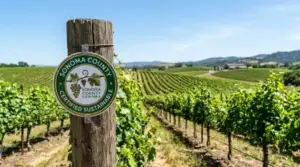
In 2014, the Sonoma County Winegrowers launched a historic initiative with an ambitious goal: to make Sonoma County the first 100% certified sustainable wine region in the world. Rather than relying on simple self-assessments, the program mandated third-party audits to verify compliance across dozens of environmental, economic, and social standards.
By reaching over 99% certified sustainable vineyard acreage, local farmers proved that broad agricultural unity is achievable. To earn certification under recognized frameworks—such as the California Sustainable Winegrowing Alliance (CSWA), Fish Friendly Farming, or SIP Certified (Sustainability in Practice)—grape growers must adhere to more than 200 best practices spanning:
- Soil Health Management: Minimizing synthetic inputs, applying organic compost, and protecting natural soil biology.
- Water Resource Conservation: Deploying precise drip irrigation networks and monitoring real-time vine stress to prevent wasteful watering.
- Energy Efficiency: Transitioning winery operations and vineyard pumps to solar microgrids and renewable energy systems.
- Human Resources & Community: Providing competitive wages, continuous safety training, and supporting local community health programs.
Regenerative Agriculture: Working with Natural Ecosystems
At the core of sustainable farming in Sonoma County is the transition from conventional agriculture to regenerative farming practices. Rather than treating the vineyard as a monoculture, local viticulturists treat the vineyard floor as a living, biodiverse ecosystem.
1. Biological Weed Control & Mowing
During the winter dormant season, many Sonoma County vineyards introduce flocks of sheep, goats, or ducks into the vineyard rows. These animals act as natural mowers, keeping cover crops and weeds under control without heavy diesel tractors or synthetic herbicides. As a byproduct, their manure naturally fertilizes the soil with organic nitrogen and micro-nutrients.
2. Cover Crops & Nitrogen Fixation
Between vineyard rows, farmers plant specialized cover crops such as clover, bell beans, vetch, and wild mustard. During spring, these crops bloom in brilliant yellows and purples, performing critical ecological functions:
- Nitrogen Fixation: Legumes pull nitrogen from the atmosphere and fix it into the soil root systems.
- Erosion Control: Deep root structures hold topsoil in place during heavy Northern California winter rainstorms.
- Beneficial Insect Habitat: Flowering cover crops attract predatory insects, such as ladybugs and parasitic wasps, which control harmful vine pests naturally.
3. Integrated Pest Management (IPM) & Raptor Nesting
To eliminate harmful rodent populations without chemical poisons, vineyard managers construct tall owl boxes and raptor perches along vineyard borders. Barn owls and red-tailed hawks hunt gophers and voles naturally, keeping vine root systems safe from subterranean destruction.
Water Stewardship along the Russian River Watershed
Water is the lifeblood of Sonoma County agriculture. With major waterways like the Russian River, Sonoma Creek, and the Petaluma River serving both human communities and delicate wildlife populations (including native Coho salmon and Steelhead trout), local winegrowers prioritize watershed protection.
Fish Friendly Farming Certification
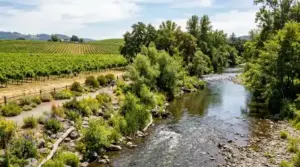
Over 50,000 acres in Sonoma County are certified under the Fish Friendly Farming program. This certification ensures that farming practices actively prevent soil erosion, reduce runoff into local streams, restore native riparian vegetation along riverbanks, and maintain stream temperatures vital for fish survival.
In addition to stream protection, growers utilize high-tech moisture sensors inserted deep into the soil root zone. These devices transmit real-time data to vineyard managers, ensuring water is applied only when the vines hit precise stress thresholds, saving millions of gallons of water annually.
Pioneering Eco-Certified Vineyards to Visit
Visitors to Sonoma County can experience sustainable viticulture firsthand by visiting certified eco-friendly tasting rooms and estate vineyards across the county’s 19 AVAs:
Benziger Family Winery (Glen Ellen)
A pioneer in biodynamic farming, Benziger converted its Sonoma Valley estate in the late 1990s. The property operates as a closed-loop system with insectary gardens, estate compost production, and wild habitat corridors.
Jordan Vineyard & Winery (Alexander Valley)
Spanning 1,200 acres in Alexander Valley, Jordan leaves nearly 80% of its total land wild and unplanted. The estate is certified sustainable and powered largely by solar power installations.
Preston Farm & Winery (Dry Creek Valley)
Operating under strict organic and biodynamic principles, Preston blends grape cultivation with heirloom grain production, olive orchards, pasture-raised livestock, and an farm store.
Preserving Northern California’s Agricultural Future
Sustainable farming in Sonoma County is far more than a marketing trend—it is a long-term commitment to ecological survival and cultural stewardship. By prioritizing soil vitality, clean water systems, native wildlife, and renewable energy, Sonoma’s agricultural community ensures that its historic valleys will remain fruitful, resilient, and beautiful for generations to come.
Whether you are sipping a glass of Russian River Valley Pinot Noir or driving past blooming mustard fields along Highway 101, you are experiencing an agricultural region that honors its land as deeply as its heritage.